DeepFakes-Generation-Using-Deep-Learning
DeepFakes Generation Techniques for Face Forensics Using Deep Learning DCGAN model
This project is maintained by SAIGANESH02
Introduction
Deep learning is a type of Artificial Intelligence (AI) that simulates the human brain’s functions in data processing, such as speech recognition, visual object recognition, object detection, language translation, and decision-making. A Generative adversarial network (GAN) is a sort of deep learning that was developed by Goodfellow et al. (2014) and is similar to convolution neural networks (CNN). When given a training set, a GAN can produce new data containing the same information as the training set, which is commonly referred to as deep fakes. CNN takes an input image and gives learnable weights and biases to different characteristics of the object, allowing it to distinguish between them. This is similar to how GAN works: it builds two neural networks, the discriminator and the generator, that work together to distinguish the sample input from the generated input (deep fakes). Deep fakes are a machine learning approach in which a person’s resemblance is changed in an existing image or video. Deep fakes have become a social problem since they allow anyone’s image to be co-opted, putting our ability to believe what we see into question. We create a GAN to generate deepfakes in this project.
Deep Fakes, GAN - Topic and Motivation
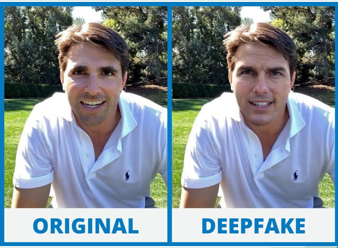
- A person in an existing image or video is replaced with someone else’s likeness.
- ML methods use Deep learning and involve training generative neural network architectures, such as autoencoders or generative adversarial networks (GANs).
- Deepfakes have garnered widespread attention for their uses in creating negative stuff.
LITERATURE REVIEW
GAN-generated Faces Detection: A Survey and New Perspectives
This paper focuses on the development methods that can detect face images generated from GAN models. They are classified into 4 categories. The models like BigGAN, StyleGan, and StyleGan2 have been developed so much that they generate realistic-looking face images with random noise input.
Realistic Face Image Generation Based on Generative Adversarial Network
In this paper the author showed how realistic fake face images can be generated by using GAN by using real images for training the model.This paper creates a model - a discriminator network and a generator network by eliminating the fully connected layer in the traditional network and applying batch normalization and deconvolution operations.
Alec Radford et al., Unsupervised Representation Learning With Deep Convolutional Generative Adversarial Networks
This paper gave insights and good clarity on the Architecture guidelines for stable Deep Convolutional GANs after performing different experimentations with different modifications to the GAN model focuses on the development methods that can detect face images generated from GAN models.
- Replace any pooling layers with strided convolutions (discriminator) and fractional-strided convolutions (generator).
- Use batchnorm in both the generator and the discriminator.
- Remove fully connected hidden layers for deeper architectures.
- Use ReLU activation in generator for all layers except for the output, which uses Tanh.
- Use LeakyReLU activation in the discriminator for all layers.
Block Diagram

Methodology
Generative Adversarial Networks (GANs) are one of the most interesting ideas in computer science today.

A generator (“the artist”) learns to create images that look real, while a discriminator (“the art critic”) learns to tell real images apart from fakes.

Two models are trained simultaneously by an adversarial process.

Result Analysis
Generated faces after training using DCGAN
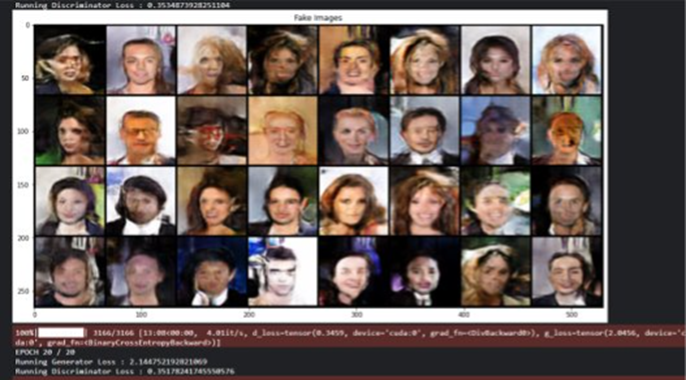
More outputs for generated faces after training using DCGAN.
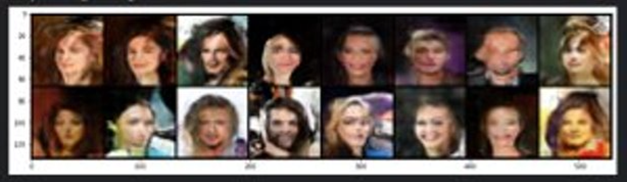
Latent interpolation GAN generated images.
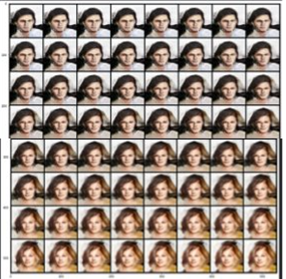
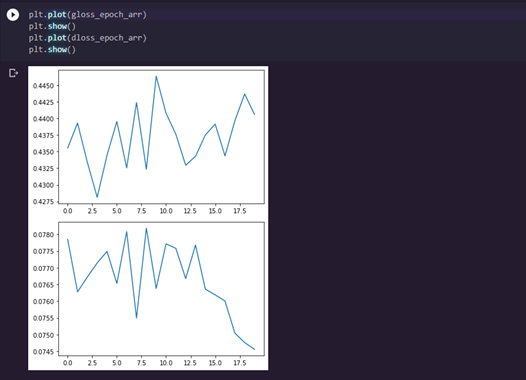
Generative and discriminative models loss history.
Conclusion
To summarize, AI outperforms humans in a variety of ways, but the key challenge is how we can use this intellect for good. For the past few years, artificial intelligence has progressed at an exponential rate. Deepfakes have escaped the spotlight due to growing concerns about privacy and deception. This technology can be used for fraud if it falls into the wrong hands. Previously, manual methods such as Photoshop were used, but now the process is automated, and the results are typically far superior. Because it is a relatively new neural network, first developed by Ian Goodfellow in 2014, it still has a number of faults that researchers are working to overcome. To summarize, we used our research to educate people about deepfakes and GAN technologies. We created a GAN to generate deepfakes of the CelebA dataset.
Thank You :)